Daily briefing

The highest-signal conversations on the future of work — what matters, parsed from what doesn’t.

Curated daily. No account needed. ~3-minute read.

IndustryGovernment & Public Sector
Top stories this weekRanked by editorial value · last 7 days

From signals to standards

From signal to skill.

We turn work signals into benchmarks people can practice and companies can trust.

Latest stories12 signals · newest published
Reddit·Essay / Analysis·7d ago

If jobs are permanently replaced by AI, what’s the plan?

Reddit discussion asking what happens if AI permanently replaces jobs, with commenters framing layoffs as a structural labor-market issue and pointing to revenue-driven permanent cuts.

Why it mattersCaptures early worker and public thinking about AI-driven job displacement, especially the economics of permanent replacement and what it means for labor demand.

1 sourceDiscuss →
RedditREDDIT
Semafor·News·11d ago

Labor Market Resilient to AI, So Far

Semafor reports that AI is affecting some jobs, but broad labor-market damage remains limited for now.

Why it mattersUseful signal on the current gap between AI adoption and large-scale job displacement; relevant for hiring, workforce planning, and automation timelines.

1 sourceDiscuss →
SemaforWEB
Semafor·News·12d ago

AI Is Coming for (Some) Jobs

Reported analysis says AI is already affecting some jobs, but adoption and impact remain uneven outside tech-heavy sectors.

Why it mattersUseful signal on where AI is translating into real labor disruption versus where adoption is still limited, which matters for hiring, reskilling, and workforce planning.

1 sourceDiscuss →
SemaforWEB
International Labour Organization·Research Report·21d ago

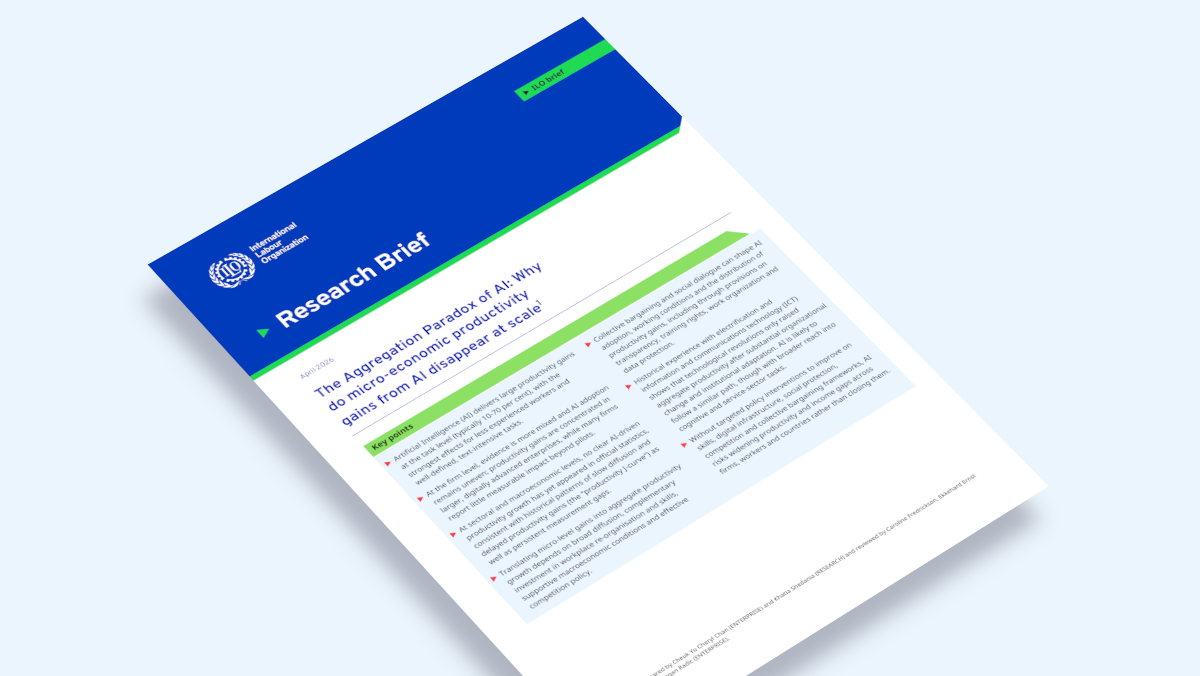
The Aggregation Paradox of AI: Why do micro-economic productivity gains from AI disappear at scale

ILO argues that AI can raise productivity at the task level without producing broad firm- or economy-wide gains unless policy and bargaining institutions help distribute and scale those gains.

Why it mattersThis frames a key question for workers and employers: who captures AI productivity gains, and what institutions are needed for those gains to show up in wages, jobs, and output at scale.

Government & Public Sector1 sourceDiscuss →
International Labour OrganizationWEB
IMF·Research Report·26d ago

AI Adoption and ...

IMF working paper examines how AI adoption affects labor-market outcomes, including wages, inequality, and which workers are more insulated or exposed to AI shocks.

Why it mattersThis is useful for understanding which workers gain protection and which face higher risk as AI spreads, and what policy levers may shape those outcomes.

Government & Public Sector1 sourceDiscuss →
IMFWEB
International Labour Organization·News·40d ago

New ILO brief explains what AI exposure indicators reveal about jobs

The ILO says AI exposure indicators should be treated as early warnings, not full predictions, and should be paired with data on jobs, wages, and worker transitions.

Why it mattersThis is a useful policy signal for anyone tracking how AI could affect work: it pushes readers past hype toward measurable labor outcomes like employment, pay, and transitions.

Government & Public Sector1 sourceDiscuss →
International Labour OrganizationWEB
GOV.UK·Research Report·56d ago

Digital and Data Benefits framework

UK government analysis uses an LLM to examine 200,000 civil service job descriptions and map more than 1.5 million tasks to likely AI augmentation or automation potential.

Why it mattersThis gives a rare task-level view of where AI could reshape public-sector work, moving the debate from abstract risk to specific jobs and duties that governments may automate, redesign, or keep human-led.

Government & Public Sector1 sourceDiscuss →
GOV.UKWEB
Apple Podcasts·Video / Podcast·68d ago

Andrew Yang on UBI, Job Loss & AI

A podcast episode featuring Andrew Yang on AI-driven job loss, UBI design, and policy responses to automation.

Why it mattersThis surfaces a mainstream policy conversation about what happens to jobs if AI keeps replacing tasks. For workers and employers, it points to debates over income support, labor-market disruption, and how society responds when work changes faster than hiring adapts.

Multiple / Cross-Industry1 sourceDiscuss →
Apple PodcastsWEB
Trend stories8 signals · older high-relevance stories
Stanford Digital Economy Lab·Research Report·91d ago

Minimum Wages and Rise of the Robots

Stanford Digital Economy Lab examines how minimum-wage changes affect firms’ incentives to adopt automation technologies.

Why it mattersThis links wage policy directly to automation pressure, showing how labor costs can shape whether firms replace, redesign, or retain work. For workers and managers, it speaks to job security, task reorganization, and the economics of adopting robots.

Multiple / Cross-Industry1 sourceDiscuss →
Stanford Digital Economy LabWEB
The Atlantic·Essay / Analysis·105d ago

America Isn't Ready for What AI Will Do to Jobs

A long-form analysis of how AI could reshape employment, with attention to recurring policy responses like UBI, retraining, and shorter workweeks.

Why it mattersIt frames AI as a labor-market and policy shock, not just a technology story, and surfaces the choices workers and institutions may face if job disruption accelerates.

Multiple / Cross-Industry1 sourceDiscuss →
The AtlanticWEB
Stanford HAI·Research Report·146d ago

AI’s on the job: What’s a worker to do?

Stanford HAI recaps evidence that hiring is falling in AI-exposed jobs, including software engineering and call-center support.

Why it mattersThis adds early evidence that AI exposure may already be affecting hiring demand in specific occupations, a key signal for workers, employers, and policymakers watching job displacement and skill shifts.

Multiple / Cross-Industry1 sourceDiscuss →
Stanford HAIWEB
NBER·Research Report·238d ago

Technology and Labor Markets: Past, Present, and Future; Evidence from Two Centuries of Innovation

A long-run NBER study suggests AI could shift labor demand toward lower-educated, lower-paid, and more male-dominated occupations.

Why it mattersThis gives readers a concrete labor-market lens on AI beyond generic disruption talk: it points to which kinds of jobs may gain or lose demand, and how that could affect wages, education premiums, and workforce composition.

Multiple / Cross-Industry1 sourceDiscuss →
NBERWEB
NBER·Research Report·299d ago

How Retrainable are AI-Exposed Workers?

NBER working paper using 1.9 million training spells to examine whether AI-exposed workers can retrain into less AI-exposed occupations.

Why it mattersThis adds evidence on a central Future of Work question: whether retraining can actually move AI-exposed workers into safer jobs, or whether transitions are limited. It matters for employers, training providers, and policymakers trying to design reskilling programs that work.

Multiple / Cross-Industry1 sourceDiscuss →
NBERWEB
The White House·Policy / Legal Document·421d ago

Fact Sheet: Eliminating Barriers for Federal Artificial Intelligence Use and Procurement

White House fact sheet on removing barriers to federal AI use and procurement, signaling how agencies may adopt AI faster and reshape internal workflows.

Why it mattersThis is a direct policy signal for how government will buy and deploy AI, which can change agency work, staffing needs, procurement standards, and the pace of automation in the public sector.

Government & Public Sector1 sourceDiscuss →
The White HouseWEB
U.S. Bureau of Labor Statistics·Research Report·511d ago

Incorporating AI impacts in BLS employment projections: occupational case studies

The BLS explains how it is folding AI into occupational employment projections through case studies and methodology updates.

Why it mattersThis shows how a core U.S. labor institution is translating AI into workforce forecasts, which can shape hiring, training, and policy expectations across occupations.

Government & Public Sector1 sourceDiscuss →
U.S. Bureau of Labor StatisticsWEB
Who's been publishingSources we track, last 30 days